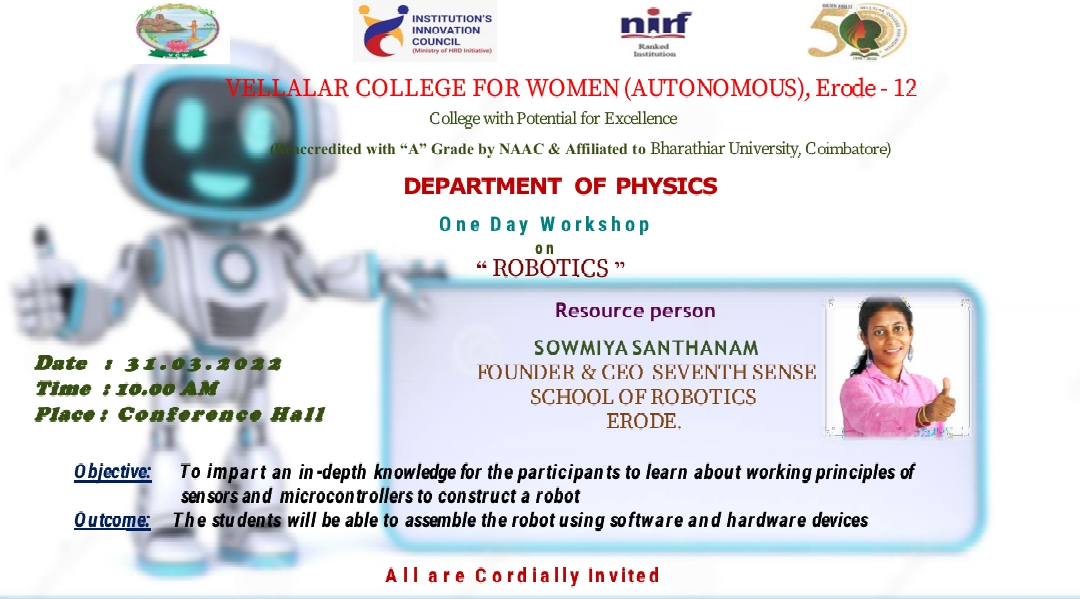
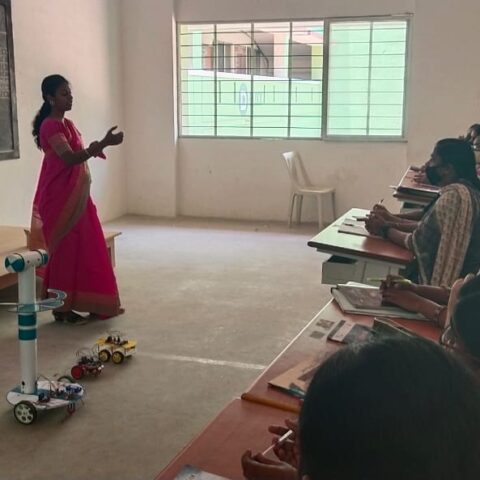
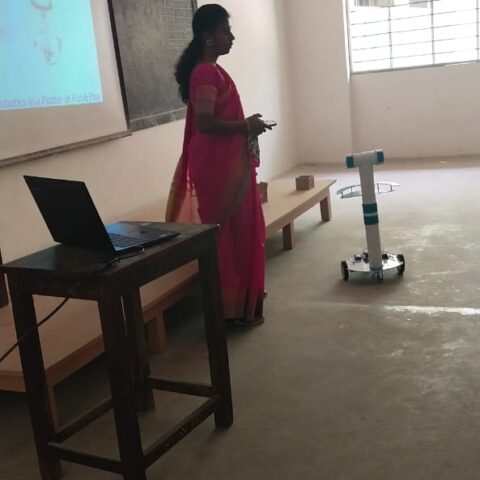
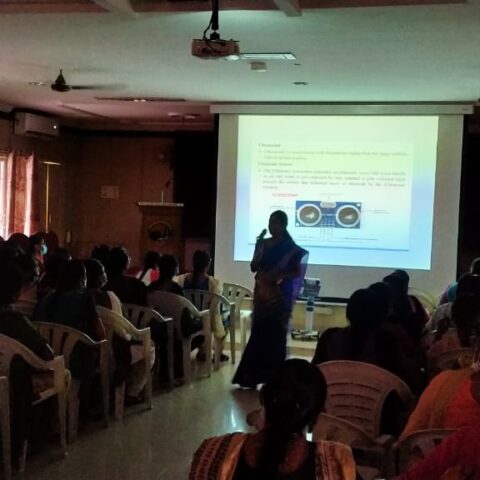
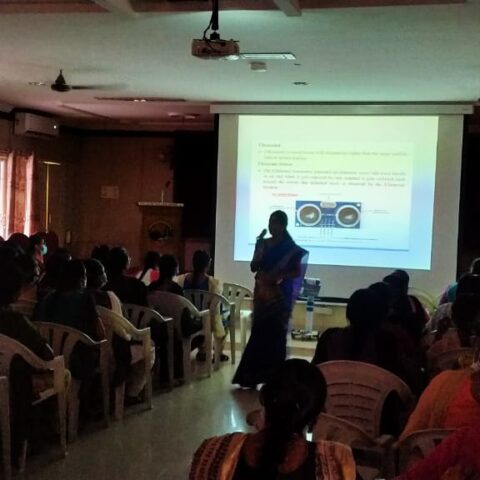
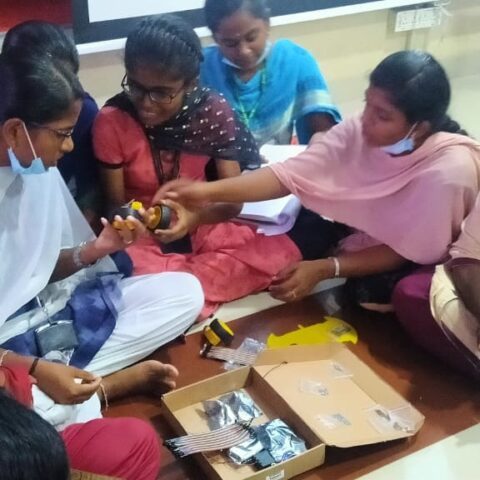
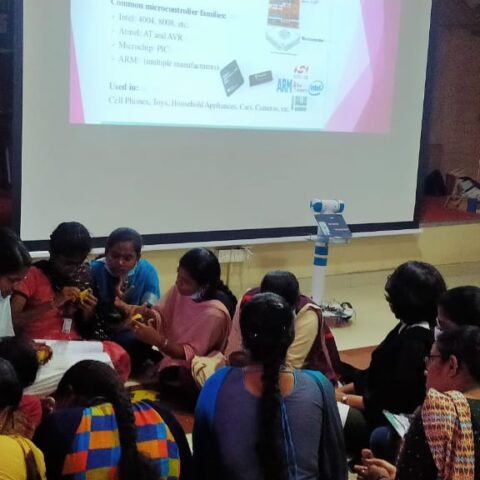
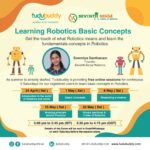
We, Seventh Sense Robotics conducting hands on training on Robotics for college students also. We are invited as resource person in Vellalar College for women by the physics department. We conducted workshop for those students every year. More than hundred students participated in workshop and gained in depth knowledge “How to do Robots”. Our main objective is to impart in- depth knowledge for the participants to teach about working principle of sensors, microcontrollers, motor driver ic to construct a robot and obstacle avoidance robot. The outcome of our workshop is the student’s assembled robotic car using hardware devices and software devices.
The topics we covered in the workshop are
What Is Robotics?
Robotics is the intersection of science, engineering and technology that produces machines, called robots, that substitute for (or replicate) human actions.
WHAT IS A ROBOT?
A robot is the product of the robotics field, where programmable machines are built that can assist humans or mimic human actions. Robots were originally built to handle monotonous tasks (like building cars on an assembly line), but have since expanded well beyond their initial uses to perform tasks like fighting fires, cleaning homes and assisting with incredibly intricate surgeries. Each robot has a differing level of autonomy, ranging from human-controlled bots that carry out tasks that a human has full control over to fully-autonomous bots that perform tasks without any external influence
WHAT ARE THE MAIN COMPONENTS OF A ROBOT?
Control system
Sensors
Actuators
Power Supply
End Effectors
What is AI?
Artificial Intelligence (AI) is nowadays the most trending topic in IT and data science. A significant number of data scientists focus on the development of AI systems such as Machine Learningand Natural Language Processing. At the same time, there is huge demand for AI systems and applications in almost every sector of the economy, including for example finance, manufacturing, defense, security and healthcare. We discussed overview of AI system and Technologies
OVERVIEW OF AI SYSTEMS AND TECHNOLIGIES
Machine Learning System
Deep Neural Networks
Natural Language Processing
Computer Vision Systems
Cognitive Search Systems
WHY SHOULD COMPANIES USE AI?
Business processes in the 21stcentury is characterized by a high level of complexity involving tasks that are stressful and inefficient to be carried out by humans. Business in today’s world is dominated by the era of data. Companies can obtain valuable insights on strategies that can radically drive growth from data.
Hence, the need for businesses to uniquely understand the needs and preferences of customers is invaluable in today’s business world; to thrive and maintain relevance within the fierce competition. Usingartificial intelligence in business, companies can now uniquely understand and engage customers, automate business processes and improve productivity and revenue while reducing operational expenses.
Most of the top companies in the world have radically adopted the use of AI. Here are some of the top companies leveraging on the power of AI.
What is a Microcontroller?
You probably have lots of these in your home although you don’t know it! A microcontroller is a type of computer in the form of an integrated circuit (IC) or “chip” which is often used in devices in your home which incorporate electronic circuitry. You have probably heard of microprocessors, e.g. Intel Pentium, and these are used as the CPU (Central Processing Unit), effectively the “brain”, in a computer. Microprocessors are integrated circuits which process the instructions in a computer program, perform calculations and send data to and from memory and disk. A microcontroller is a specific type of microprocessor. It differs from a normal microprocessor in the following ways:
It has built in “I/O” (input/output) capabilities. So it can read and write digital and analog values/states, and connect directly to the “real world”. A microcontroller, unlike a microprocessor can connect directly to switches, buttons, LCD displays, LEDS, relays and serial ports
Microcontrollers are generally used for low to medium complexity, specific tasks in equipment. This contrasts with the powerful, number crunching microprocessors used in PCs which handle a variety of software applications.
Microcontrollers are often used in portable devices which run on batteries, e.g. digital cameras. So they are often low powered with a small current consumption (unlike the heat sinked, fan cooled microprocessor in a desktop computer)
Compared to the microprocessor in a PC, the RAM within a microcontroller can typically range from 64k down to as little as 1k
The program in a microcontroller is usually stored in EPROM or EEPROM. This is a type of non volatile (program doesn’t disappear when the device is turned off) memory which can be continuously wiped and rewritten.
What is an Arduino?
Arduino is an open source hardware/software programming platform based around Atmel microcontrollers. Open source means that circuit schematics and source code of software used in designs is freely available and can be modified by enthusiasts. Arduino development boards with their analog and digital, inputs and outputs, are ideal for artists, designers and electronic hobbyists who wish to put together a system without having to know a huge amount about digital design. Input and output signals are made available on the Arduino board using rows of female connectors into which individual leads or single in line (SIL) connectors can be plugged.
Micontroller Projects — Programming an Arduino Board
Arduino boards are programmed in C and high level functions are provided as standard for reading and writing to analog and digital pins and serial ports. Source code is known as a “sketch”. Standard libraries are also available for tasks such as output to an LCD panel or communication with a GSM module.
A basic code editor/compiler is available on the Arduino website which can be used for developing programs. However the editor is basically just like Wordpad and doesn’t provide any color coded highlighting or have sophisticated debug features. Atmel Studio, a cut-down, customized version of Visual Studio is an alternative which provides these features.
Programs are downloaded onto an Arduino board using either a serial port or USB connection. A bootloader then loads the program into memory on reset so that an external programmer isn’t required.
What Can an Arduino Board Be Used For?
An Arduino board can be used for doing lots of cool stuff. You can easily add LCD displays, a keypad or seven segment display modules and build a simple system quickly. Lots of information and libraries are available on the Arduino.cc website. You can design your own add on electronics or use shields to build a modular system. Arduinos because of their versatility can be used for simple, mundane tasks or complex applications. An example of a simple application would be the ability to turn on a device when the temperature in a room falls below a certain level. It wouldn’t be too difficult to extend this application, and add a GSM module which could send out a text message when this occurs. Arduino boards can be used to implement a complex home automation system which could be controlled over a smart phone. They are also used by enthusiasts as the processing and control device in robots, and kits are available for building a simple wheeled robot.